
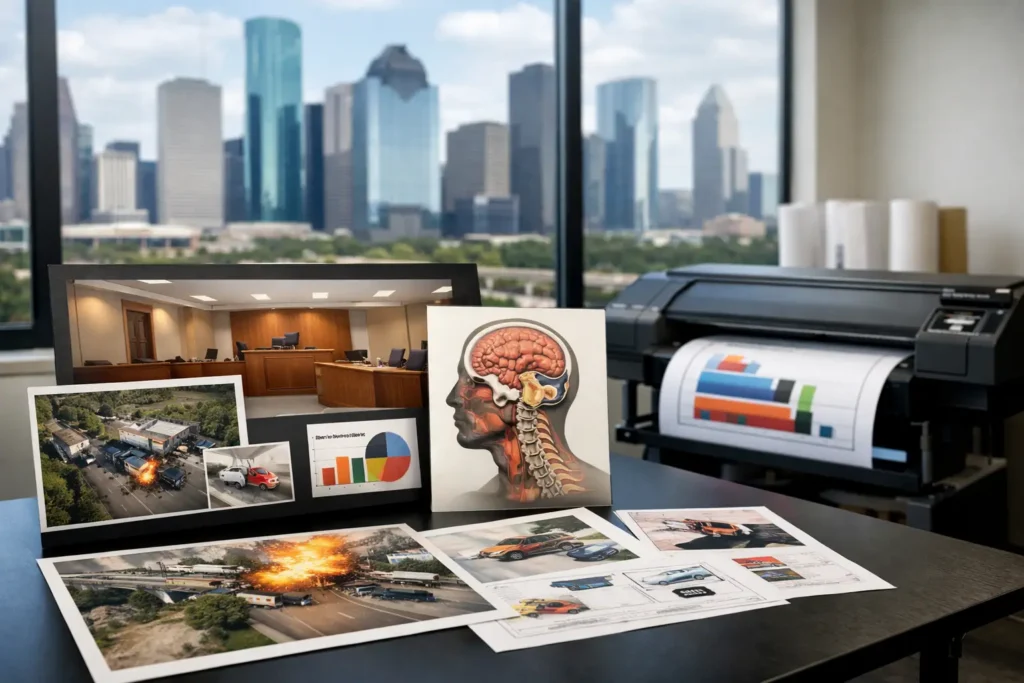
A search for “trial graphics printing Houston” usually begins when a legal team has more information than a jury can reasonably absorb. The deadline is close, the exhibits are still changing, and a weak visual could blur an otherwise strong argument. Trial graphics are not decorative add-ons. They are working courtroom tools that help attorneys organize facts, establish chronology, explain technical issues, and keep testimony understandable.
For Houston litigation teams, the challenge is not simply getting boards printed. It is producing accurate, court-ready visuals while protecting confidential material, managing version changes, and meeting a schedule that may shift with little notice. That requires a local production partner that understands both print quality and the demands of litigation support.
What Effective Trial Graphics Must Accomplish
A good trial exhibit answers a question before it creates another one. A juror should be able to understand the main point from a reasonable viewing distance, then find the supporting detail without searching through crowded text or low-resolution images.
That standard changes the way graphics should be designed and printed. A timeline needs a clear sequence and enough contrast to separate dates, events, and key documents. A medical illustration must remain legible without overstating what the record supports. An engineering diagram needs labels that stay sharp when enlarged. In every case, visual clarity serves the argument, but accuracy comes first.
Effective graphics also need to work in the actual courtroom. Lighting, display easels, monitor placement, room size, and the distance between the jury and counsel table all affect what people can see. A graphic that looks clean on a laptop may become unreadable once it is mounted on a board or shown across the room.
Trial Graphics Printing in Houston Starts Before Press Time
The most preventable problems in trial graphics production happen before anything is printed. Files may contain missing fonts, low-resolution photographs, incorrect page dimensions, inconsistent colors, or late edits that were not reflected across related exhibits. In legal work, even a minor version mismatch can create unnecessary distraction.
A careful preflight review checks that artwork is sized for the intended output, images will reproduce cleanly, and the latest approved content is being used. It also creates a practical checkpoint for questions such as whether an exhibit number is correct, whether the board needs mounting, and whether a color image should also have a legible grayscale backup.
This review matters most when several people are contributing to the exhibit set. Attorneys, paralegals, experts, consultants, and litigation-support staff may each have source materials or revisions. A dedicated account manager gives the team one point of contact to confirm instructions, track updates, and keep production moving without making counsel chase multiple vendors.
Choosing the Right Format for the Courtroom
There is no single best format for every trial. The right choice depends on the evidence, courtroom technology, how often the exhibit will be handled, and whether it must remain available during deliberations or witness examination.
Mounted boards remain valuable because they are immediate and reliable. They do not depend on a courtroom display connection, software compatibility, battery level, or an internet connection. They are especially useful for timelines, photos, maps, demonstratives, organizational charts, and documents that need to stay visible while a witness explains them. Foam board, gator board, or other rigid mounting options can be selected based on durability and the expected handling.
Large-format paper exhibits can be a smart choice when the work is detailed, frequently revised, or needed in quantity. Engineering plans, site maps, medical records, and dense document enlargements may be printed as oversize sheets, with or without lamination. This approach can reduce cost and make last-minute revisions easier than remounting a full board set.
Lamination adds protection and can make frequently handled exhibits more durable. The trade-off is glare. A glossy finish may make colors appear vivid but can reflect courtroom lighting. Matte lamination generally reduces reflections and fingerprints, which is often the better choice for boards presented under bright lights.
Digital presentation files have their place, particularly for animated timelines, video clips, document callouts, and complex data. Still, digital exhibits should not be treated as a replacement for every physical visual. Technology can fail at the worst possible moment. Many trial teams prepare printed backups of their most important graphics so the presentation can continue if a screen, cable, or courtroom system becomes unavailable.
Build for Readability, Not Just Visual Impact
Legal teams often need to fit extensive facts into limited exhibit space. The answer is rarely smaller type. When a graphic tries to communicate every detail at once, it can lose the audience before testimony has a chance to explain it.
Start with the point the exhibit must make. Then use hierarchy to guide the viewer: a direct headline or date range, strong labels, restrained color, and enough white space to separate information. Supporting detail can remain available in a handout, source document, or a second exhibit rather than competing for attention on the main board.
Color should be purposeful. It can distinguish parties, identify stages in a timeline, or call attention to a specific area of an image. But relying on red versus green alone can create accessibility issues, and using many unrelated colors often makes a graphic harder to follow. High contrast between text and background is usually more valuable than dramatic color effects.
Photographs, scans, and screenshots deserve special attention. Enlarging a poor image does not improve it. It only makes the weakness larger. When source material is limited, a production team can help determine whether cropping, careful enhancement, a document enlargement, or a different presentation method will provide the clearest result without changing the substance of the evidence.
Plan for Revisions Without Losing Control
Late changes are part of litigation. A deposition may alter the emphasis of a timeline, a ruling may affect what can be displayed, or an expert may provide a revised figure shortly before trial. The goal is not to pretend revisions will not happen. The goal is to make them manageable.
Use clear file names and designate a single approved version for production. Confirm exhibit numbers, quantities, finishing, delivery location, and required completion time in writing. When updates are sent, identify exactly what changed instead of asking a print provider to compare large files line by line under deadline pressure.
It also helps to prioritize exhibits by importance. Print the case-critical boards first, then move to supplemental materials, binders, and backup copies. If time is tight, this approach protects the pieces counsel cannot do without. Local Houston pickup and delivery can further reduce risk by removing the uncertainty of shipping a time-sensitive exhibit set across the city or from an out-of-state provider.
Why Local Production Matters When Trial Dates Move
A national online printer may appear convenient when a project is routine and the deadline is generous. Trial work is different. Physical proofs, secure file handling, quick corrections, and direct access to the people managing the job can matter far more than a standard checkout process.
A local provider can review a last-minute sample, produce replacement boards, coordinate a weekend delivery, or make a fast change after a courtroom requirement becomes clear. That responsiveness is not only about speed. It is accountability. Legal teams need to know who is watching the details and who will answer the phone when the exhibit list changes at 6 p.m.
The Document Group supports Houston legal teams with trial graphics, litigation copying, scanning, e-discovery support, and the practical production services that surround a case. Keeping these capabilities under one accountable local partner can reduce handoffs when the workload is heavy and the calendar is unforgiving.
The strongest trial graphics do not compete with the attorney or the evidence. They make both easier to follow. When the next hearing or trial date is approaching, give your visuals enough time for a careful review, a clear production plan, and a dependable local handoff. That preparation gives the legal team one less thing to worry about when it matters most.