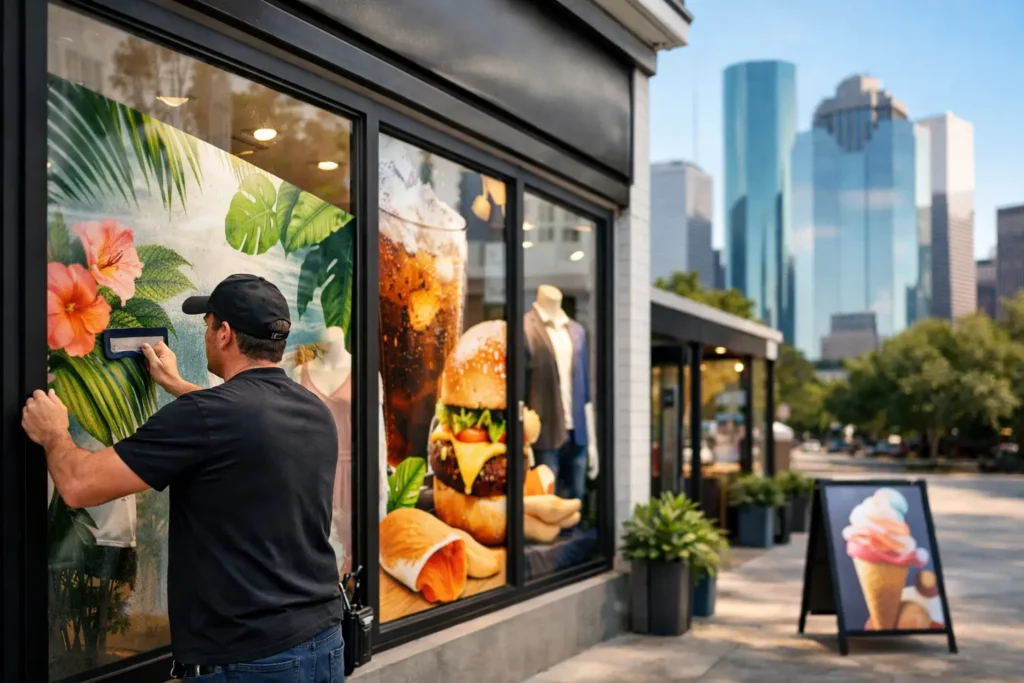
A storefront has only a few seconds to explain who you are, what you offer, and whether someone should walk through the door. Custom storefront graphics can do that work every day, turning bare glass, exterior walls, and entryways into clear, professional brand statements. The right graphic layout makes a location easier to find, supports promotions, and gives customers confidence before the first conversation begins.
For Houston organizations, the decision is not simply about printing a logo larger. Heat, humidity, intense sunlight, frequent rain, property requirements, and high-traffic locations all affect which materials and installation methods make sense. A graphic that looks great on day one but fades, lifts, or conflicts with the lease can create an expensive problem later.
Custom Storefront Graphics Houston Companies Can Plan Around
The strongest storefront graphics begin with a practical question: what should a person understand from the street, parking lot, or sidewalk? A retail shop may need to communicate its name, product category, and current offer. A medical office may need discreet wayfinding and a polished entrance. A law firm, engineering company, or professional-services office may want a more restrained look that reinforces credibility without covering the entire storefront.
This is why design should follow the viewing distance. Small details that look sharp on a computer screen can disappear from across a parking lot. A primary message needs contrast, readable type, and enough scale to work from where customers actually approach the building. Secondary information, such as hours, a suite number, or a phone number, can sit closer to the door where visitors have time to read it.
Brand consistency matters just as much. If the storefront uses a different logo color, type style, or message than your business cards, interior signs, vehicle graphics, and trade-show displays, the business can feel less established. A coordinated visual system helps customers recognize they have arrived at the right place.
Choose Materials for the Location, Not Just the Look
Storefront graphics are not one product. The best option depends on the glass, wall surface, expected lifespan, lighting, local conditions, and whether the graphic needs to be removed at the end of a lease.
Window Vinyl for Clear Messaging
Vinyl window graphics are a practical choice for displaying logos, operating hours, services, seasonal offers, and directional information. They can cover a small portion of the glass or create a larger visual treatment across multiple windows. For storefronts with strong sun exposure, material selection and proper finishing help preserve color and appearance over time.
Full window coverage can be effective for vacant-facing offices, retail displays, or areas where privacy is needed. But it is not always the right answer. Covering too much glass can make an interior feel dark or closed off. It can also reduce visibility into a retail environment where seeing activity, merchandise, or a welcoming staff member encourages customers to enter.
Perforated Film When Visibility Matters
Perforated window film provides graphics on the exterior while allowing people inside to see outward through the glass. It can be useful for storefront windows, vehicle-style visibility applications, and locations where a large brand image is needed without fully blocking the view.
The trade-off is that perforated film does not deliver the same solid, opaque appearance as standard vinyl. It also needs to be evaluated carefully for nighttime conditions. Interior lighting, exterior lighting, and the direction of the viewer all influence how the graphic performs. A production partner should ask about those conditions before recommending it.
Wall Graphics and Entrance Features
Exterior wall graphics can help a business stand out where window space is limited. Inside the entrance, branded wall graphics can reinforce the experience once a visitor comes in. These are especially useful in shared office buildings, medical facilities, training centers, and event spaces where the storefront itself may be only one part of the customer journey.
Wall surfaces require attention. Smooth painted drywall, textured masonry, metal panels, and stucco do not accept graphics the same way. Surface compatibility, cleaning, and installation conditions matter. Applying the wrong adhesive film to a difficult surface can shorten the life of the graphic and affect removal later.
Get the Site Details Right Before Production
A storefront project can move quickly when the right information is gathered early. Accurate measurements are essential, but so are photos of the entry, windows, adjacent signage, and surrounding conditions. These details help determine panel breaks, graphic placement, installer access, and whether the finished work will be visible from the intended approach.
Property-management and landlord approvals should be addressed before print production begins. Many buildings have rules about window coverage, approved colors, mounting methods, exterior sign placement, and temporary promotional materials. Depending on the type of sign and location, local permitting requirements may also apply. Clarifying those details upfront avoids rushed redesigns or materials that cannot be installed as planned.
A good proofing process should show more than the artwork alone. It should identify the finished dimensions, placement, materials, and any important production notes. For multi-location businesses, a documented approval process is especially useful. It keeps Houston-area locations aligned while allowing for site-specific differences such as window sizes, suite numbers, and building restrictions.
Design for Customers Who Are Moving
People rarely study storefront graphics from a perfect, stationary position. They may be driving through a shopping center, walking from a parking garage, or trying to find a suite while carrying paperwork or equipment. The design needs to work under those real conditions.
Keep the primary message focused. A storefront is not the place to list every service, credential, or product category. One strong identifier, a clear supporting line, and limited contact information often perform better than a crowded layout. Contrast is critical, particularly on glass where reflections and changing daylight can compete with the image.
Consider the location’s visual environment as well. A bright retail center may require bolder graphics than a professional office corridor. A restaurant near a major road may prioritize fast readability. A healthcare practice may choose frosted privacy film with a simple logo treatment to create a calmer, more confidential feel. There is no universal formula, which is why site conditions should guide the final design.
Installation Is Part of the Finished Product
Even excellent graphics can fail when installation is rushed or the surface is not prepared properly. Glass should be cleaned correctly, measurements verified, and installation scheduled around weather and site access when exterior work is involved. Large panels need precise alignment so logos, patterns, and text look intentional across seams and frames.
Timing also deserves attention. Businesses often need graphics installed before a grand opening, lease turnover, promotional launch, or trade event. Building an installation date into the production schedule helps avoid last-minute compromises. For projects with several moving pieces, one accountable project contact can coordinate artwork approvals, printing, installation requirements, pickup, and delivery without leaving the customer to manage separate vendors.
The Document Group supports Houston businesses with visual-display production that is handled with the same deadline discipline applied to complex print and document projects. That matters when storefront graphics are one part of a larger rollout that may also include banners, interior signs, printed collateral, window decals, or event materials.
Keep Storefront Graphics Current
A storefront graphic is not necessarily permanent. Seasonal promotions, new services, changing hours, relocations, and rebrands all create reasons to update the display. Temporary vinyl can be a smart fit for short campaigns, while longer-term materials are usually a better value for core brand elements that will remain in place for years.
Plan for maintenance from the beginning. Staff should know which cleaning methods are appropriate and avoid abrasive tools or chemicals that can damage printed surfaces. If a graphic begins to lift, fade, or show damage, address it early rather than waiting for a small issue to affect the overall presentation.
The best storefront graphics make a business easier to recognize and easier to trust. When the materials, message, site conditions, and installation plan all match, the result is more than decoration. It is a dependable part of how customers find the door, understand the brand, and decide to come inside.