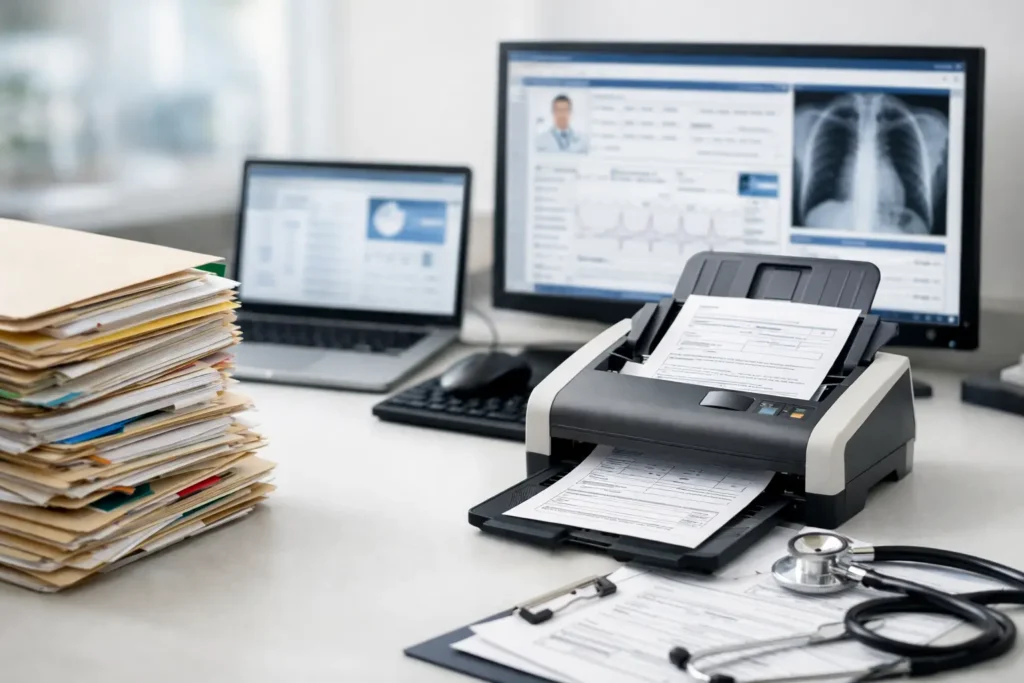
A medical-record storage room can become a daily operational problem long before it looks full. Staff lose time pulling charts, refiling records, answering requests, and working around boxes that should not be occupying valuable office space. Medical records scanning services turn those paper files into organized digital records, but the real value is not simply creating image files. It is creating a dependable process for finding the right information when it is needed.
For Houston healthcare administrators, practice managers, and records teams, a scanning project has to balance speed with careful handling. Patient records may be active, archived, incomplete, oversized, or stored in mixed formats. The provider that treats every carton like ordinary office paper can create more work than it removes.
What Medical Records Scanning Services Should Accomplish
A well-planned conversion gives authorized staff faster access to records while reducing the burden of physical storage. Instead of searching by date, patient name, or chart number through filing cabinets, the team can retrieve a scanned record through the indexing method chosen for the practice or facility.
That sounds straightforward, but record retrieval depends on the quality of the preparation and indexing that happens before and during scanning. A crisp image is not enough if it is attached to the wrong patient file, named inconsistently, or missing pages. For medical offices, hospitals, specialty practices, and third-party administrators, accuracy is the service.
The right project also accounts for how records will be used after conversion. A clinic that needs occasional access to inactive charts may use a different file structure than a healthcare group preparing records for frequent retrieval, review, or a system migration. The best approach depends on the volume, document condition, retention requirements, and destination for the final files.
Start With the Records Workflow, Not the Scanner
The fastest path to a usable digital archive begins with a clear intake plan. Before records leave a file room or storage area, the scanning team and client should establish what is being scanned, how files will be grouped, which fields will be indexed, and how exceptions will be handled.
Common index fields include patient name, medical record number, date of birth, date range, and record type. Not every project needs every field. Adding more index points can make future retrieval easier, but it can also add time and cost. For a large archive of inactive charts, a practical indexing plan may be more valuable than an overly detailed one that slows the project without helping staff find records faster.
Paper condition matters too. Records often include folded pages, sticky notes, narrow receipts, color forms, photographs, double-sided pages, and documents with staples or damaged edges. Preparation should remove fasteners, repair torn pages when needed, and identify items that require special handling. If the collection includes microfilm, microfiche, radiology-related documents, or oversize materials, those formats need their own conversion plan rather than being forced into a standard paper workflow.
Accuracy Requires Quality Control at Every Stage
In medical-record digitization, the most costly error is often not a poor scan. It is a record that cannot be located, a page that was skipped, or a document filed under the wrong identifier. Quality control needs to address both the image and the record structure.
A responsible workflow includes chain-of-custody procedures during pickup, transport, intake, production, and return or secure disposition. It also includes image review to check readability, orientation, completeness, and proper file association. For records with handwritten notes, faint carbon copies, or colored annotations, scan settings should be selected to preserve usable detail rather than simply producing the smallest possible file.
Healthcare organizations should discuss privacy expectations, access controls, and handling procedures with any scanning provider before a project begins. HIPAA responsibilities do not disappear because records are being converted to digital files. Clear expectations around authorized access, secure storage, transfer methods, and final disposition protect both the organization and the patients whose information is being handled.
Plan for Active Records Without Interrupting Care
Archived files are usually the easiest place to start, but many organizations also need to scan active records. That is where operational planning becomes especially important. A chart may be needed for a patient visit, a billing question, a physician review, or a records request while it is in the conversion process.
Some teams prefer a phased schedule by date range, provider, department, or record status. Others use smaller batches and scheduled pickups so records are away from the office for a limited period. There is no single correct method. The right choice depends on how often staff retrieve paper charts and whether the organization has a reliable way to track records that are temporarily in production.
For time-sensitive work, a local provider can be a practical advantage. Houston-area pickup and delivery reduce the coordination involved in moving large quantities of confidential files. Direct communication with an accountable project manager also makes it easier to address a priority batch, a missing chart question, or a change in scope without waiting on a distant call center.
Decide What “Done” Means Before Work Begins
A scanning project is not finished when the last page has been imaged. The final delivery must fit the client’s daily workflow. That may mean searchable PDF files, structured folders, files delivered through an approved transfer method, or records prepared for upload into a document management or electronic health record environment.
Searchability can be useful, particularly for typed documents, but it should be understood correctly. Optical character recognition can help staff search within many scanned pages, yet handwritten notes and low-quality originals may not produce reliable text results. Indexing remains essential when accurate retrieval is required.
It is also wise to determine what happens to the paper originals. Some organizations need files returned in their original order. Others retain them for a defined period before approved destruction. Records subject to retention schedules, legal holds, audits, or pending requests require particular care. A documented decision on return, storage, or destruction prevents confusion after the digital files have been delivered.
Questions to Ask Before Choosing a Scanning Partner
The most useful conversations focus on process, not promises. Ask how the provider tracks boxes and files, who has access to the records, how exceptions are documented, and what quality checks are performed. Confirm how files will be named and indexed, how you will receive them, and who will be your point of contact if a question arises.
It is also reasonable to ask for a sample workflow or pilot batch. A small test can confirm image quality, indexing conventions, and delivery format before the larger archive moves forward. It gives staff a chance to test whether the final files are actually easy to retrieve in the way they work.
Price matters, but an unusually low per-page estimate may not reflect preparation, indexing, special-size documents, quality review, or secure logistics. A clear quote that defines the project scope is easier to manage than a low starting price followed by avoidable changes.
Make Space for Better Work
When medical records are scanned with the right controls, the benefit reaches beyond the records room. Staff spend less time filing and searching. Offices reclaim space. Authorized teams can retrieve information more consistently, even when a chart is no longer sitting in a nearby cabinet.
The Document Group helps Houston organizations move from paper-heavy record storage to practical, organized digital files with hands-on project oversight, quality control, and local service. Whether the need is a backlog of inactive charts or a carefully phased conversion, the strongest next step is a conversation that defines the records, the retrieval needs, and the process before the first box is picked up.