
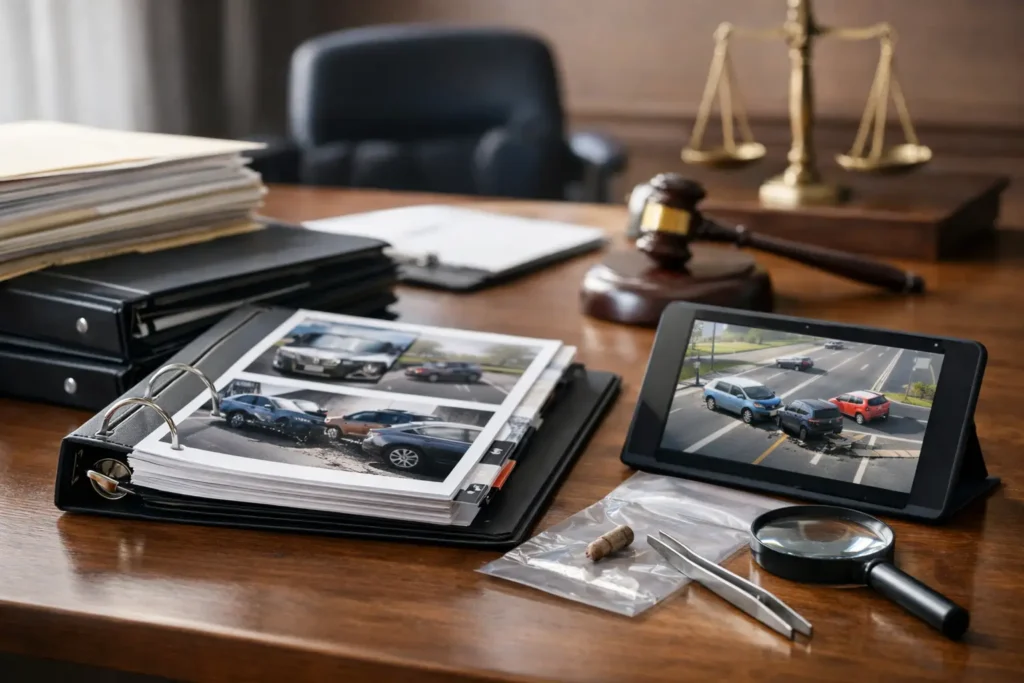
A trial team should not be discovering a missing page, an unreadable scan, or a mismatched exhibit number when a witness is on the stand. Legal exhibit production is the behind-the-scenes work that makes evidence usable in the room: correctly identified, easy to read, consistently organized, and available in the format the court, counsel, and jury need.
The stakes are practical. A persuasive document can lose its force if its key language is too small to see. A demonstrative can distract from testimony if the labels do not match the exhibit list. And an otherwise routine production job can become a last-minute problem when revisions, binders, boards, and delivery are handled by separate vendors. Careful production gives the legal team one less variable to manage.
What Legal Exhibit Production Actually Includes
Legal exhibit production is more than printing a stack of PDFs. Depending on the matter, it can include preparing deposition exhibits, hearing binders, trial notebooks, jury books, exhibit boards, timelines, medical-record chronologies, oversized plans, electronic exhibit files, and demonstrative graphics. The common requirement is control: every version, label, page, and output must be intentional.
For a contract dispute, that may mean producing clean, tabbed copies of agreements and correspondence with Bates numbers that remain legible. For a construction case, it may mean enlarging plan sheets or site photographs without compromising detail. In a medical or personal injury matter, it may involve organizing lengthy records into indexed binders and producing visual timelines that help the fact finder follow a complicated sequence of care.
Not every exhibit needs the same treatment. A deposition may call for durable, clearly labeled paper sets that travel well and can be marked in real time. A bench trial may require a tightly controlled set of courtroom binders and electronic files. A jury trial may benefit from large-format displays and trial graphics that make a dense issue understandable from across the courtroom. The right production plan depends on the venue, the judge’s procedures, the case team’s workflow, and the volume of material.
Start With a Production Plan, Not a Print Order
The most reliable exhibit work begins before files are released for printing. Counsel and litigation-support staff should identify what is final, what may change, who approves proofs, and where the materials must be delivered. This prevents a common and expensive problem: producing a complete set of binders, then learning that the exhibit list changed or a redaction was updated.
A practical production plan answers a few operational questions early. How many sets are needed for the court, witnesses, opposing counsel, the client, and the trial team? Will exhibits be marked before production or at the hearing? Are color pages essential to meaning, or can selected documents be produced in black and white? Does the courtroom permit electronic presentation, printed boards, or both? Is there a need for weekend delivery, secure pickup, or after-hours revisions?
It also helps to establish a single source of truth. The legal team should designate the approved file location and naming convention, then avoid sending competing versions by email. A production partner can work from a final folder or secure file-transfer workflow, but the client team still needs clear approval authority. One attorney or litigation-support lead should be able to say, plainly, which files are ready to produce.
Build in a proofing checkpoint
Proofing is not a formality. It is where teams catch issues that are cheap to correct before production and disruptive to correct afterward. Review a representative proof of each format, including tabs, covers, boards, enlargements, and color-sensitive documents.
Look closely at page orientation, clipped content, image clarity, page numbering, Bates ranges, confidentiality labels, redactions, and exhibit stickers. If an exhibit will be enlarged, check that small type remains readable at the intended viewing distance. If it will be inserted into a binder, confirm that hole punching, tabs, and binding do not obscure important content.
Accuracy Is a Chain of Small Decisions
Exhibit errors rarely come from one dramatic failure. More often, they result from a series of small assumptions: a file was thought to be final, a color page was output in grayscale, a tab name was abbreviated differently, or a revised exhibit was placed behind an earlier version.
That is why quality control should follow the production path. Files should be checked before output, samples should be reviewed during production, and finished sets should be counted and inspected before delivery. For high-volume matters, it is also useful to validate an exhibit list against the physical or electronic set. The goal is not simply to produce attractive materials. It is to ensure that each recipient receives the correct materials in the expected order.
Redactions deserve particular care. A visible black box on a page is not automatically a secure redaction in an electronic file. Legal teams should confirm that the underlying information has been properly removed in the approved source document before distribution. A production provider can help reproduce the approved file accurately, but legal review of the redaction itself remains essential.
Choose Formats That Support the Argument
Good legal exhibit production respects the difference between evidence and presentation. The exhibit must remain faithful to the source material. The presentation format should make that material easier to locate and understand without changing its meaning.
Printed binders remain valuable because they are stable, easy to annotate, and familiar in depositions, mediations, and courtrooms. Clear covers, sturdy binding, readable tabs, and logical indexing make a long record less cumbersome. Color printing is often worth the added cost when charts, photographs, tracked changes, maps, or highlighted fields carry meaning. When color does not add value, black-and-white production can help control a large case budget.
Oversized exhibits serve a different purpose. A site plan, engineering drawing, email chain, medical image, or timeline may need a larger format so the audience can actually see it. Mounted boards can be effective for a key document or chronology, while posters and removable graphics may fit a short hearing or mediation. The trade-off is portability and revision risk. Large displays require more handling and are less forgiving when last-minute facts change, so they work best when the content is settled.
Electronic exhibits can reduce paper volume and support courtroom presentation, but they need the same discipline as printed sets. File names, folder structure, exhibit numbering, searchable text, and access controls should be planned in advance. Keep a reliable backup copy and confirm compatibility with the courtroom’s equipment rather than assuming a laptop, projector, or media format will work on arrival.
A Reliable Exhibit Workflow for Deadline-Driven Matters
When the schedule is tight, clarity matters more than complexity. A dependable workflow usually includes these five controls:
- Confirm the final exhibit list, numbering, and required quantities.
- Deliver approved files through a secure, organized transfer method.
- Review proofs for formatting, color, redactions, tabs, and labels.
- Produce, assemble, and quality-check every set against the approved plan.
- Arrange tracked pickup, delivery, or courtroom drop-off with a clear handoff contact.
This process is especially helpful when legal teams are coordinating discovery, deposition preparation, trial graphics, and day-to-day case work at the same time. Rather than chasing multiple vendors for printing, scanning, bindery, oversized output, and delivery, the team can keep responsibility with one accountable production partner.
For Houston-area firms and corporate legal departments, local capacity can make a meaningful difference when a hearing is moved up, a witness binder changes overnight, or a large-format exhibit must be replaced quickly. The Document Group combines litigation support, digital printing, scanning, trial graphics, and local delivery so the production side of a case can move as quickly as the legal strategy does.
Treat the Last 24 Hours as Part of Production
The final day before a hearing or trial is when even a well-planned project can change. New rulings may affect what is included. A deposition designation may shift. Counsel may need additional sets for a witness, a mediator, or the courtroom clerk. The best response is not panic printing. It is a documented revision process that identifies what changed, which copies are affected, and who has approved the replacement.
Keep a simple record of final quantities, delivery destination, recipient name, and time required. If materials are split between a courtroom, hotel war room, and office, label packages clearly and avoid assuming that one person will distribute everything correctly. A short handoff confirmation can prevent an avoidable scramble.
The strongest exhibits do not call attention to their production. They let the attorney, witness, and evidence do their work. When each page is readable, each set is complete, and each delivery arrives where it belongs, the legal team can stay focused on the argument that matters.