
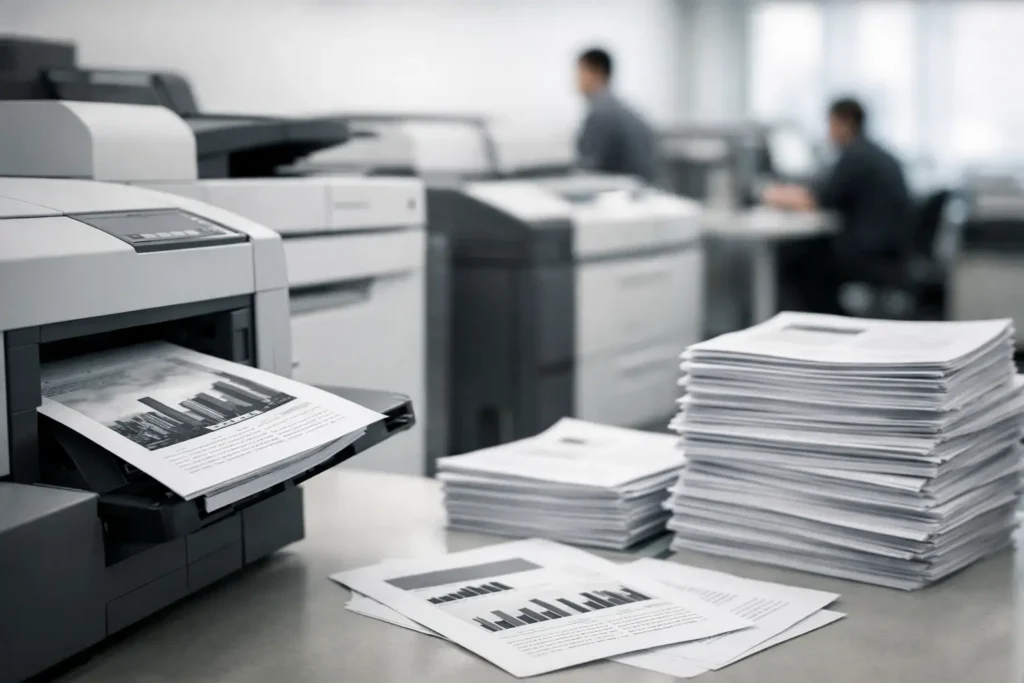
A 2,000-page production run does not need color to be critical. For a legal team preparing deposition sets, a healthcare office processing patient records, or an engineering firm issuing updated specifications, black and white printing is often the most practical way to produce readable, consistent documents under a real deadline.
The right print partner does more than put toner on paper. They help confirm files, select the appropriate paper and finishing, maintain document order, protect confidential materials, and get completed sets where they need to be. When volume is high and the details matter, those controls make the difference between a finished project and a costly scramble.
Why Black and White Printing Still Matters
Color has a clear role in marketing materials, presentations, maps, charts, and branded communications. But many operational documents are designed to be read for their content, not their visual impact. Contracts, pleadings, discovery productions, manuals, invoices, policies, medical records, training packets, and internal reports usually benefit more from clean text, reliable reproduction, and economical volume pricing than from full-color output.
Black and white printing keeps per-page costs manageable, especially when a project involves thousands of pages or multiple sets. It also supports faster production planning because the focus stays on sharp text, solid blacks, accurate pagination, and dependable finishing. For organizations that print regularly, those efficiencies add up quickly.
That does not mean every page should automatically be converted to grayscale. A spreadsheet with color-coded exceptions, a construction plan with colored layers, or a medical record with color images may lose meaning when printed in black and white. The practical approach is to identify which pages truly require color and print the balance in black and white. This hybrid method can control costs without compromising usability.
When Black and White Printing Is the Best Fit
Black and white output is a strong choice when information density is high and accuracy is nonnegotiable. Legal teams often need duplicate sets of motions, exhibits, transcripts, and discovery materials that are easy to review, mark, copy, and organize. Consistent reproduction helps ensure that every set is complete and that page references remain dependable across the matter.
Healthcare and administrative teams face similar needs. Patient records, billing documentation, compliance files, policies, and archived records can become overwhelming when stored as loose paper or mixed-format files. High-quality monochrome printing provides a clear working copy for review, routing, or retention while keeping production costs appropriate for large document volumes.
Technical and engineering organizations also rely on black and white printing for specifications, operating manuals, field packages, reports, and plan sets where black line work is sufficient. If a drawing depends on color coding, color may be necessary. If it relies on line weight, labels, and dimensions, a properly calibrated black-and-white output can be the more efficient option.
For office managers and operations leaders, the deciding factors are usually volume, deadline, confidentiality, and distribution. A few dozen internal documents may be easy to handle in-house. Several hundred collated, tabbed, bound, and delivered sets are a different kind of assignment. That is where professional production support reduces pressure on internal staff and equipment.
Quality Is More Than Dark Toner
A readable page starts with the source file. Low-resolution scans, faint originals, handwritten notes, and poorly converted files can all affect the finished result. A capable production team reviews the job before it moves into full production, looking for concerns such as clipped margins, missing pages, incorrect orientation, blank pages, or pages that need to be enlarged for legibility.
Text density matters as well. Small legal disclaimers, financial tables, and detailed records can look acceptable on screen but become difficult to read when printed at actual size. Paper selection, printer calibration, and scaling settings affect how those details reproduce. There is no single setting that works for every project, which is why a quick proof or file review can prevent a larger issue later.
Consistency matters most in multi-set jobs. A single set can be checked page by page. A production run of 50 or 500 sets requires a controlled process: verified files, stable equipment, clear instructions, organized finishing, and quality checks during the run. For legal, medical, and technical documents, an out-of-order page or missing exhibit can have consequences far beyond the print room.
Finishing Decisions That Improve Usability
Printing is only one part of document production. The way a set is assembled affects how easily people can use it in a meeting, at a deposition, in the field, or during trial preparation. Simple finishing choices should match the document’s purpose.
Three-hole drilling works well for materials going into existing binders. Coil or comb binding can make manuals and training documents easier to turn and keep together. Stapling may be appropriate for shorter packets, while tabs and section dividers help reviewers move quickly through lengthy reports, exhibits, or record sets. Covers, sheet protectors, and laminating can add durability when documents will be handled repeatedly.
These choices involve trade-offs. A heavily bound volume looks polished, but it may be less convenient to scan or copy later. Tabs improve navigation, but they add production time and should be planned early. If documents are headed to court, a client, a jobsite, or a records department, discuss the intended use before the project is produced. The best finishing option is the one that supports the work being done after delivery.
Preparing Files for Faster, Cleaner Production
Most production delays are preventable. Before sending files for black and white printing, confirm the final page size, page count, copy quantity, and whether the job is single-sided or double-sided. Double-sided printing can reduce paper use and package size, but it is not ideal for every document. Items with tabs, heavy annotation needs, or frequent page removal may work better single-sided.
Keep file names clear, particularly when a project includes multiple volumes or versions. For sensitive materials, provide straightforward instructions for collation, labeling, shipping, pickup, and delivery. If there are exceptions, such as specific pages that must print in color, identify them before production begins rather than after the full run is complete.
For scanned originals, ask whether image cleanup, OCR, or indexing is needed before printing. OCR can make scanned documents searchable and easier to review, while indexing supports efficient organization of large record collections. These services are especially useful when paper archives need to become working digital files as well as printed sets.
Choosing a Partner for Deadline-Driven Print Work
The lowest per-page quote is not always the lowest project cost. A missed delivery, incomplete set, unreadable reproduction, or unclear communication can cost far more than a small difference in print pricing. For urgent and high-volume work, look for a provider that can explain the production plan, confirm job specifications, and remain accountable through delivery.
Local service also has practical value. Pickup and drop-off can save time when files, originals, proofs, or completed materials need to move quickly. Extended availability matters when filings, hearings, project deadlines, or event schedules do not fit neatly into standard business hours. A dedicated account manager gives clients one clear point of contact instead of asking them to coordinate separate print, scanning, binding, and delivery vendors.
The Document Group supports Houston organizations with black-and-white production, secure scanning, litigation copying, oversized documents, and finished presentation materials under one accountable process. That breadth is useful when a project starts as a paper archive, becomes a searchable digital file, and ends as organized hard-copy sets for review or distribution.
Black and white printing works best when it is treated as part of the workflow, not as an afterthought. Start with a clear purpose for each set, protect the details that must remain visible, and give the production team enough information to manage the job correctly. That preparation creates the kind of result people notice for the right reason: everything is clear, complete, and ready when it is needed.