A presentation binder that arrives with uneven tabs, a set of construction plans printed at the wrong scale, or 300 event handouts delivered a day late can create far more work than the print job was meant to solve. Commercial printing is not simply putting ink on paper. For organizations with deadlines, it is a production process that has to protect accuracy, support a clear message, and arrive where it is needed when it is needed.
For office managers, legal teams, healthcare administrators, engineers, and marketing coordinators, the right printing partner removes friction from the process. That means clear specifications, consistent color, dependable finishing, secure handling of sensitive files, and one accountable contact from quote through delivery.
What Commercial Printing Should Solve
Business printing has to do more than look professional. It needs to fit the way your team works. A proposal may need a polished cover and durable binding for an executive meeting. A litigation team may need indexed production sets, labeled exhibit binders, and replacement copies on short notice. An engineering firm may need full-size plans that preserve line weights and dimensions. A marketing team may need brochures, banners, window graphics, and event materials that all represent the same brand.
Those requirements call for production planning, not a one-size-fits-all order form. Before printing begins, define the job’s purpose, audience, quantity, deadline, distribution method, and required finish. These decisions affect the best print method and help prevent last-minute changes that add cost or delay.
A capable provider should also ask practical questions. Will the piece be mailed, carried to a meeting, posted outdoors, or used repeatedly at a trade show? Does it contain confidential information? Is the source file ready for production, or does it need adjustment? Small details such as paper opacity, fold direction, bleed, page order, and binding edge can determine whether a finished piece works as intended.
Choosing the Right Commercial Printing Method
Digital and offset printing both have a place in a well-run print program. The better choice depends on quantity, turnaround, versioning, color needs, and budget.
When digital printing makes sense
Digital printing is often the practical choice for short runs, variable information, and urgent deadlines. It is well suited to presentation sets, training manuals, sales materials, booklets, legal copies, and documents that need frequent updates. Because setup time is minimal, digital production can move quickly from approved file to finished piece.
It also works well when each copy is not identical. A company can personalize mailers, add location-specific information to collateral, or produce separate sets for different departments without treating every version as a completely new job. For time-sensitive work, that flexibility matters.
The trade-off is that per-piece pricing may become less favorable as quantities increase. Some specialty papers and highly specific color requirements may also point to another process. A good account manager will explain the options rather than automatically steering every job to the fastest machine.
When offset printing is the better fit
Offset printing is generally a strong choice for larger-volume projects that require consistent, refined reproduction. Brochures, catalogs, annual reports, stationery programs, and large direct-mail quantities often benefit from offset production. Once the job is set up, the cost per piece can be more economical at higher volumes.
Offset also provides broad flexibility in inks, paper stocks, and special finishes. If precise brand color is central to the project, discuss it early. A logo color viewed on a monitor, a color printed digitally, and a color produced with offset inks are not always identical. Providing approved brand standards and requesting a proof when color is critical helps set the right expectation before full production begins.
The trade-off is lead time. Offset requires more preparation than digital printing, so it may not be the right answer for a job needed tomorrow. Planning ahead gives you more choices and can reduce production pressure without compromising quality.
Start With Files That Print Correctly
Many production issues begin before a file reaches the print room. A document can look correct on screen and still produce unexpected results if images are low resolution, fonts are not embedded, page sizes are inconsistent, or elements sit too close to the trim edge.
For commercial printing, a print-ready PDF is usually the safest starting point. Images should be high enough resolution for their final printed size. Full-bleed designs need bleed beyond the final trim line, while text, page numbers, and logos need adequate safety margins. If your document will be bound, remember that punched holes, coil binding, and saddle stitching all affect usable space near the edge.
For technical plans and drawings, confirm the intended output scale before release. For legal and medical documents, verify that Bates numbering, divider labels, confidentiality markings, and page order are finalized. It is easier to correct a source file than to reprint hundreds of finished documents.
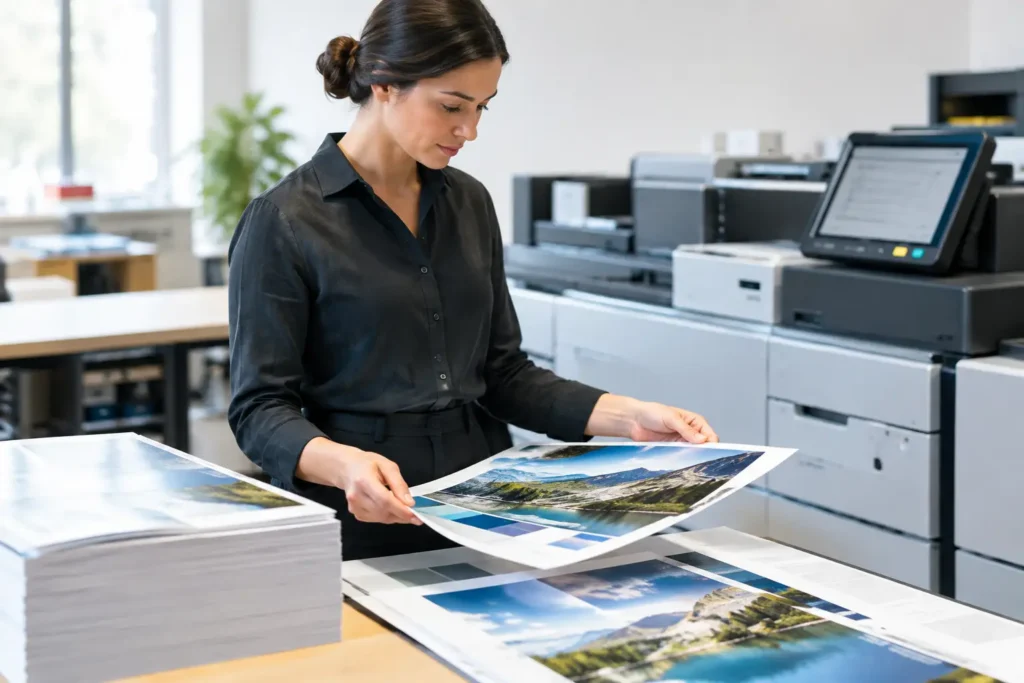
Proofing is not a formality. Assign someone who understands the content and the purpose of the piece to review a proof carefully. Check names, numbers, addresses, dates, charts, page breaks, and contact information. For a multi-part project, compare all components together. A banner, brochure, table tent, and handout can each look good on their own while still feeling inconsistent as a set.
Paper, Finishing, and Format Are Functional Choices
Paper stock affects both appearance and performance. A heavier cover stock can give a proposal or booklet more authority, while an uncoated sheet may be easier to write on. Gloss stocks can make images and color stand out, but glare may be a concern under bright meeting-room lighting. Matte and silk finishes often offer a balanced, professional look for materials that combine text and photography.
Finishing should support the job’s real use. Lamination protects frequently handled materials, including menus, field reference sheets, identification cards, and signs. Tabs make long binders easier to navigate. Folding can turn a flat sheet into a compact handout, but panel sizes must be designed to fold properly. For manuals and reports, choose a binding method based on page count, durability, and whether the document needs to lie flat.
Common options include saddle stitching for smaller booklets, coil binding for materials that need to open flat, and perfect binding for thicker, polished publications. Three-ring binders can be useful when documents will be updated over time, especially for training, operations, and litigation materials. The right option depends on use, not just appearance.
Plan for Urgent and High-Stakes Work
Rush projects happen. A hearing is moved up, a client meeting is added, equipment plans are revised, or an event shipment arrives incomplete. The goal is not to pretend urgency never occurs. It is to work with a provider that has the capacity, communication habits, and local logistics to respond when it does.
When a deadline is tight, send complete files and instructions in one package whenever possible. State the quantity, size, color requirements, finishing, delivery location, and hard deadline. Identify which decisions are fixed and where substitutions would be acceptable. For example, if a preferred stock is unavailable, would a comparable matte stock work? If a custom binding cannot be completed in time, is a high-quality alternative acceptable?
For confidential projects, speed should never override handling procedures. Legal records, medical files, personnel documents, and proprietary materials require careful control throughout scanning, printing, copying, and delivery. Ask how files are received, how physical documents are tracked, who can access the job, and how completed materials are returned or retained.
Local service has real value when documents are large, complex, or deadline-driven. Pickup and delivery, in-person proof review, and direct access to the person managing the job can prevent avoidable mistakes. The Document Group supports Texas organizations with hands-on project oversight, extended availability, and production services that cover routine business printing as well as demanding legal, technical, and visual-display needs.
Get More Value From Every Print Order
The lowest quoted price is not always the lowest total cost. Reprints, missed deadlines, poor color, damaged materials, and time spent coordinating multiple vendors all carry a cost. A reliable commercial printing partner helps reduce those risks by catching issues early and managing the project as a whole.
If your organization places recurring orders, standardize what can be standardized. Keep approved files, paper selections, finishing instructions, brand colors, and delivery details on record. Create repeatable specifications for common items such as business forms, training binders, presentation folders, plan sets, and event signage. Consistency saves time, makes ordering easier, and gives your team a dependable baseline when an urgent request appears.
The best print projects feel uneventful to the people waiting for them. Files are checked, questions are answered quickly, materials are produced accurately, and finished work arrives ready to use. That is the standard worth asking for when the documents in front of your clients, court, staff, patients, or project team need to perform without excuses.