
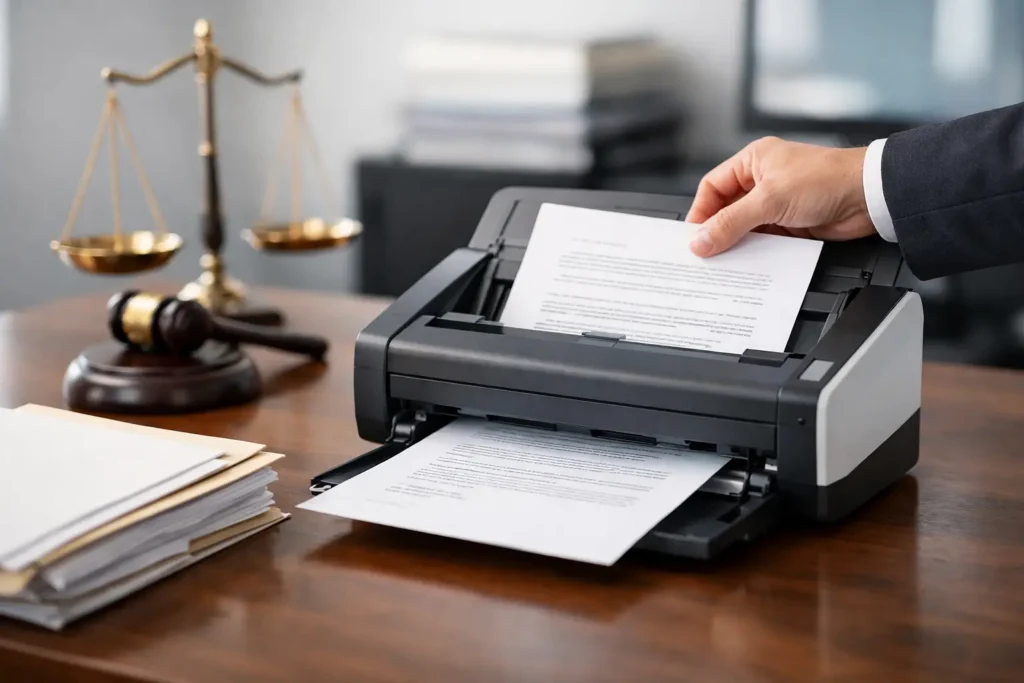
A banker box is not a records-management strategy, especially when a filing deadline, deposition, audit, or client request depends on finding one page quickly. Legal document scanning services turn paper-heavy case files into usable digital records, giving legal teams faster access to information without sacrificing the organization and accuracy that legal work demands.
For Houston law firms, corporate legal departments, and litigation-support teams, the goal is not simply to convert paper into PDFs. The real objective is to create a reliable document set that can be searched, reviewed, shared appropriately, and produced when the pressure is on. That requires a scanning partner that understands chain of custody, document preparation, image quality, indexing, and tight turnaround expectations.
What Legal Document Scanning Services Should Deliver
Legal files are rarely clean, uniform stacks of standard letter-size pages. A single matter may include pleadings, correspondence, discovery productions, medical records, contracts, photographs, exhibits, handwritten notes, oversized drawings, and legacy files pulled from storage. Each document type creates different handling and quality-control requirements.
A professional scanning project begins with preparation. Staples, clips, sticky notes, and damaged pages must be handled carefully so that every page is captured and returned in the proper sequence. Documents may need separator sheets, matter-level grouping, or specific naming conventions before scanning begins. This early work is where many do-it-yourself efforts lose time and introduce errors.
Image quality matters just as much. A file may technically scan successfully while still being difficult to read because of faint handwriting, poor contrast, skewed pages, missing margins, or incorrectly oriented images. Legal teams need legible records that hold up during review, production, and trial preparation. Quality control should confirm page counts, image clarity, orientation, and completeness before files are released.
The final files should also be useful. Searchable PDFs created through optical character recognition can make a large record collection far easier to review. Indexing can organize files by client, matter, document type, date range, custodian, or another agreed-upon structure. The right approach depends on how the records will be used after scanning.
Start With the Use Case, Not the Scanner
The best scanning workflow depends on the job ahead. A closed-file archive project has different requirements than records needed for an active lawsuit next week.
For long-term storage, a firm may prioritize consistent file names, searchable text, retention categories, and efficient storage. For active litigation, the priority may be rapid access, careful bates labeling, document-level indexing, secure transfer, and compatibility with an e-discovery workflow. Medical records often require detailed chronology support or separation by provider and date. Engineering or construction disputes may include oversized plans that must remain readable at full scale.
This is why asking for a flat “per-page” price without defining the workflow can be misleading. Per-page scanning costs may not account for preparation, special handling, indexing, OCR, color requirements, oversized sheets, rush production, or delivery format. A clear project scope gives everyone a better path to accurate pricing and a usable result.
Before sending files out, decide what success looks like. Will the documents be imported into a document-management system? Are they being prepared for discovery review? Does the team need text-searchable PDFs, image-only files, or both? Should original files be returned, boxed for storage, or securely destroyed according to a documented authorization process? These decisions prevent avoidable rework later.
Security Has to Be Part of the Process
Legal records can contain privileged communications, personally identifiable information, financial details, protected health information, and confidential business material. Security should be built into the scanning workflow, not treated as a promise at the end of a proposal.
A reliable provider should be able to explain how files are received, logged, stored, scanned, transferred, and returned. For pickup projects, that may include documented handoffs and secure transportation. Within production, access should be limited to trained personnel assigned to the work. Digital delivery should follow an agreed method suited to the sensitivity and volume of the files.
There is no single best delivery method for every matter. Encrypted media can make sense for a large, closed transfer. A secure file-transfer process may be better for staged delivery. Litigation teams may need files loaded into a review or hosting environment. What matters is that the delivery method is discussed before production starts, rather than improvised after thousands of pages have been scanned.
Retention is another practical consideration. Ask how long the provider retains working copies after delivery and how deletion is handled. If original documents are being destroyed after imaging, establish written approval, retention requirements, and confirmation procedures first. The lower-cost option is not always the lower-risk option when the records cannot be recreated.
Why Local Project Oversight Matters
Large scanning projects involve small decisions that can become expensive problems if no one owns them. A folder may contain mixed matters. A scan may reveal missing pages. A document may require color because a highlighted clause or redlined revision matters. An oversized exhibit may need separate handling. These are not unusual exceptions in legal work. They are part of the work.
A local partner can inspect material in person, arrange pickup and drop-off, and respond quickly when priorities change. That is especially valuable when a case team needs portions of a collection delivered first, a production deadline moves forward, or trial preparation creates a sudden need for copies, exhibit boards, binders, and scanned records from the same source.
The Document Group supports legal teams with scanning, litigation copying, e-discovery services, trial graphics, and production support under one accountable local team. That broader capability can reduce the handoffs that often slow down deadline-driven matters. Instead of moving files among separate scanning, printing, and litigation vendors, teams can coordinate a project through a dedicated point of contact.
Questions to Ask Before Choosing a Scanning Provider
The right provider should answer operational questions directly. Ask how they prepare and track files, what quality-control checks are performed, whether they can scan mixed-size and fragile records, and how they handle color pages, foldouts, and oversized documents. Ask what indexing options are available and whether the files can be delivered in the format your team needs.
It is also worth discussing capacity and turnaround in real terms. “Fast” means little without knowing the volume, condition of the documents, required indexing, and deadline. A few boxes of clean, standard-size files may move quickly. A warehouse archive with damaged folders, mixed media, and document-level indexing will need a more detailed schedule. A dependable provider will identify those variables early instead of promising a turnaround that ignores the actual workload.
For active cases, ask whether priority processing or phased delivery is available. Receiving the most urgent custodians or date ranges first can keep attorneys moving while the remaining work continues. For matters with production deadlines, clarify whether printing, bates stamping, copying, and electronic delivery can be coordinated in the same workflow.
A Better Way to Clear the File Room
Scanning does not require an all-or-nothing decision. Some organizations begin with closed matters that consume premium office space. Others start with a single active case, a medical-record archive, or documents needed for a merger, audit, or relocation. A pilot project can help establish naming rules, indexing standards, and delivery preferences before a larger conversion begins.
The paper itself should be treated as a business decision after digitization. Some originals must be retained because of legal, regulatory, client, or evidentiary requirements. Others may be returned to storage or approved for secure destruction. The scanning provider can support the workflow, but the retention decision belongs to the organization and its counsel.
A well-run scanning project creates more than empty shelves. It gives the people handling a matter a clearer path from question to document, even when the file was created years ago and the deadline is tomorrow. When records need to be found, reviewed, and produced without delay, choosing a careful local team is a practical investment in the work that follows.