A banner has only a few seconds to do its job. From across a parking lot, trade-show aisle, lobby, or jobsite fence, people need to read the message, recognize the brand, and know where to look next. That is why large format banner printing is more than sending a logo to a printer. Material, viewing distance, finishing, placement, and installation conditions all affect whether a banner looks professional when it matters.
For businesses, banners also have to contend with heat, humidity, wind, sudden rain, and demanding event schedules. A good display starts with the intended use, not simply the biggest available size.
Start With the Job the Banner Must Do
Before selecting a material or approving artwork, define the banner’s purpose. A storefront promotion, a construction-site notice, a directional sign for a conference, and a sponsor backdrop each require a different approach. The same artwork may not work equally well in every setting.
Think about where viewers will stand. A banner intended to be read from 10 feet away can support more detail than one facing traffic from 50 feet away. Long headlines, high-contrast colors, and large contact information are usually more effective for distance viewing than a crowded layout. If a phone number, URL, suite number, or event date is essential, it should remain readable without forcing people to stop and squint.
Placement matters just as much. An indoor banner can prioritize color and presentation, while an outdoor banner needs to account for wind exposure, mounting points, and weather. For temporary promotions, a lightweight option may be the practical choice. For a display that will remain up for months, durability and reinforcement should lead the conversation.
Choosing Materials for Large Format Banner Printing
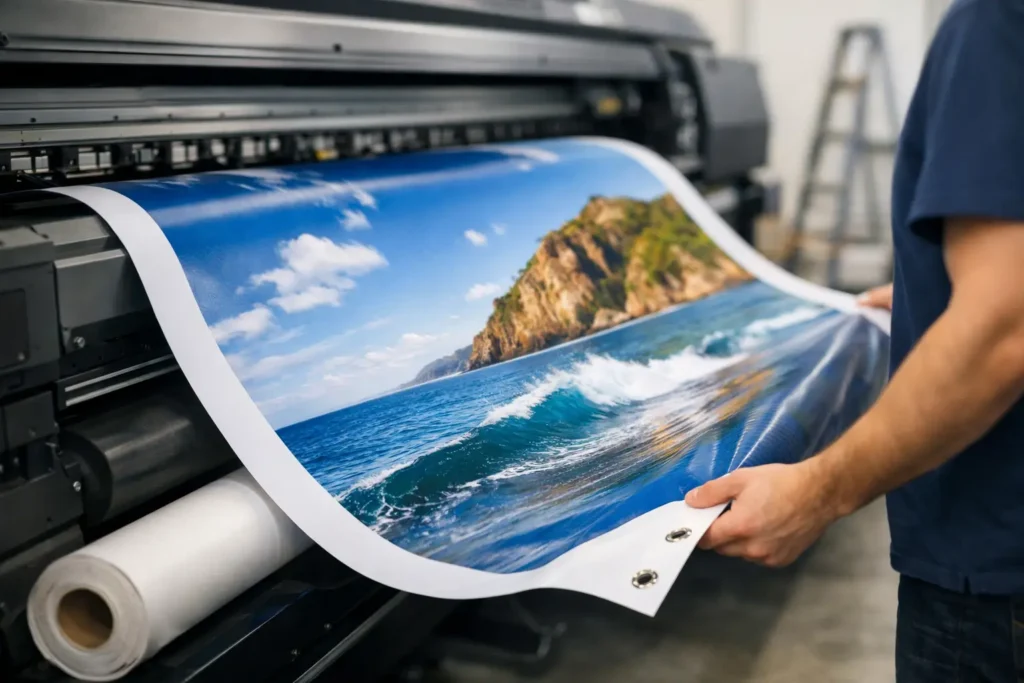
Banner material should reflect the environment, expected lifespan, and installation method. Vinyl remains a common choice because it is durable, versatile, and suitable for many indoor and outdoor applications. However, not all vinyl banners perform the same way.
A smooth solid vinyl banner generally provides a clean surface for bold graphics, photographs, and event messaging. It works well for storefront promotions, indoor displays, fence signage, and temporary outdoor campaigns. Heavier material may be worth the added cost when a banner will be reused or installed in a more exposed location.
Mesh vinyl is designed for windy conditions. Its small perforations allow air to pass through, which can reduce stress on mounting hardware and the banner itself. The trade-off is that the printed image is not as opaque or sharp at very close range. On a fence, building wrap, or open outdoor site, that trade-off is often sensible. For a photo backdrop or interior presentation, solid material may deliver a better visual result.
Fabric banners can offer a more polished appearance for indoor events, branded environments, and presentations where glare is a concern. They are often easier to transport and can look less utilitarian than vinyl. Still, fabric is not automatically the right answer for every project. Outdoor durability, available finishing options, and the need for frequent cleaning should be reviewed before production.
Size Is About Viewing Distance, Not Just Available Space
Businesses sometimes order a banner based solely on the dimensions of a wall, booth, or fence. That can result in a display that technically fits but fails to communicate. A banner needs enough open space around its message to be noticed and enough letter height to be read from the expected distance.
For a trade-show booth, a wide horizontal banner may establish the company name and services above the display area. For a sidewalk-facing promotion, a vertical banner may use limited space more effectively. A jobsite banner can be much larger, but it should still keep the core message simple. People driving past do not have time to process multiple service lines, a detailed mission statement, and several calls to action.
This is where professional artwork review is valuable. A production team can flag copy that is too small, images that may soften when enlarged, or design elements that sit too close to the edge. Files created for email, social media, or standard office printing are rarely ready for a large display without adjustment.
Use Images and Colors That Print Clearly
Large banners are forgiving from a distance, but they are not immune to poor source files. A low-resolution logo can look acceptable on a screen and still appear pixelated when printed several feet wide. Whenever possible, provide vector logo files or high-resolution artwork. This helps preserve crisp type, clean lines, and professional color reproduction.
Color also deserves careful planning. Dark text on a light background is generally easier to read at a distance than low-contrast combinations. Brand colors should be represented accurately, but legibility comes first. A dark blue headline on black may look dramatic in a digital mockup and disappear outdoors. Bright sunlight can wash out subtle contrast, while indoor lighting may introduce glare on certain materials.
Photographs can be effective when they support the message rather than compete with it. If a photo is used as a full background, place text over a calmer area of the image or use a solid color field behind the copy. The goal is not to fill every inch of printable space. The goal is to make the banner work quickly and clearly.
Finishing Determines How the Banner Performs
A banner is only as dependable as its edges and mounting points. Grommets, hems, pole pockets, reinforced corners, and other finishing details should be selected based on how the banner will be installed.
Grommets are a practical option for many banners mounted to walls, fences, or frames. They provide defined attachment points, but spacing and tension matter. Pulling a banner too tightly can create stress around the grommets, especially in wind. A hem adds strength along the edge and is often a smart choice for larger pieces or longer-term use.
Pole pockets are useful when a banner will hang from a rod, slide onto a stand, or attach to a specific display system. They create a cleaner presentation than visible grommets in many indoor applications. The key is confirming the pole diameter and the exact mounting arrangement before production begins.
For outdoor installations, do not treat finishing as an afterthought. A strong banner with insufficient mounting hardware can tear, sag, or become a safety concern. If the location receives frequent wind, a mesh material, reinforced edges, and a thoughtful installation plan may save time and replacement costs later.
Plan for the Deadline Before It Becomes Urgent
Banner projects often begin with a familiar request: an event is approaching, a site opens soon, or leadership needs new signage by the weekend. Fast production is possible, but accuracy still depends on getting the basics right early. Confirm the final size, quantity, material, finishing, artwork, installation date, and delivery location before the job moves into production.
It also helps to consider the full display package. A banner may need matching yard signs, window graphics, directional signage, mounted boards, or handouts. Coordinating those pieces with one production partner reduces color inconsistencies and prevents last-minute gaps at the event or location.
For time-sensitive projects, The Document Group provides hands-on project oversight, large-format production, and local pickup and delivery support. That matters when a banner is one piece of a larger opening, trial presentation, field operation, or trade-show plan.
A banner should not become another deadline problem for your team. Give it a clear purpose, make it readable from the right distance, and build it for the conditions it will face. The result is a display that looks intentional on installation day and stays effective through the moment it was made to support.