A trade show deadline has a way of exposing every weak link in a marketing plan. The booth space is booked, the team is scheduled, and then someone realizes the backdrop is the wrong size, the banner copy is outdated, or the tabletop display will not arrive in time. Thoughtful trade show display printing prevents those last-minute problems and gives your team a professional, credible presence when conversations matter most.
For Houston organizations, the right display is not simply a large printed image. It is a production decision involving booth dimensions, viewing distance, lighting, travel, installation, brand standards, and a firm event deadline. The best approach starts with the job the display needs to do, then selects materials and graphics that support it.
Start With the Booth, Not the Artwork
A display can look excellent on a computer screen and still underperform on the show floor. Before designing or submitting files, confirm the exhibit space dimensions, the booth configuration, height restrictions, and whether the display will sit against a wall or be visible from multiple sides. Ask the event organizer about fire-retardant material requirements, hanging-sign rules, electrical access, and loading-dock procedures as well.
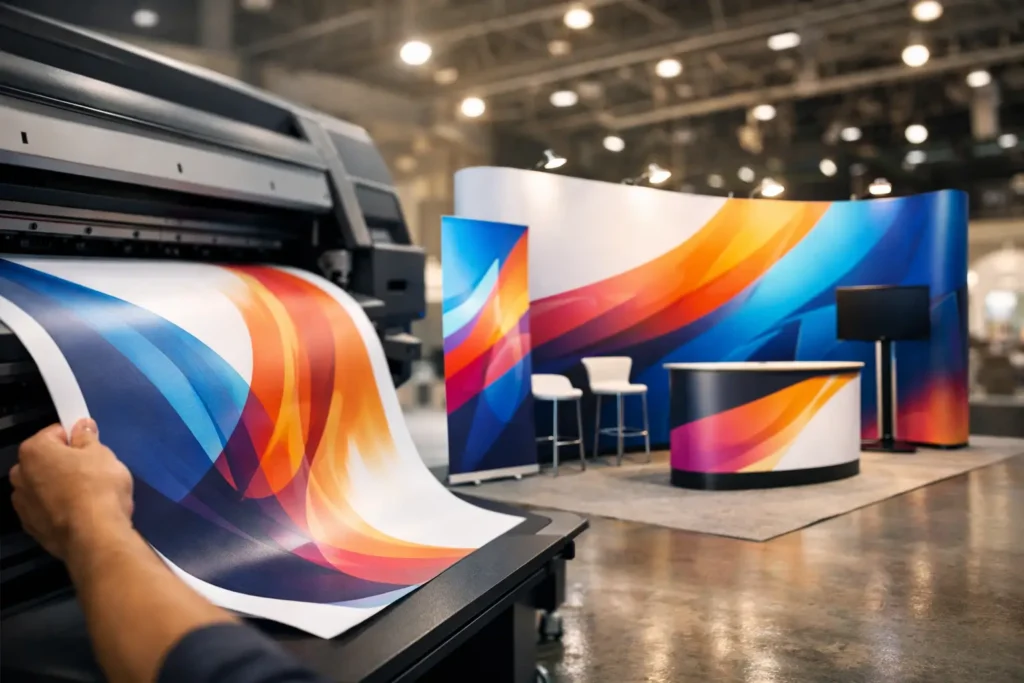
A 10-foot inline booth has different needs than an island exhibit. In a smaller footprint, a full-width backdrop can establish your brand quickly while a retractable banner handles a focused message or product benefit. In a larger space, a combination of back walls, counters, fabric displays, floor graphics, and directional signs may make more sense. More pieces are not always better. If the booth feels crowded, attendees may pass by without understanding where to look first.
Think about sightlines. Your company name and primary message should be readable from the aisle, not only by visitors already standing inside the booth. Secondary information can live closer to eye level, where staff can use it to support a conversation.
Choose Trade Show Display Printing Materials for Real Conditions
Display materials should fit the event and how often you plan to use them. A lightweight retractable banner is easy to carry, quick to set up, and useful for recurring events. It may not create the same visual impact as a large tension-fabric wall, but it is often the more practical choice for a team traveling with limited staff or vehicle space.
Fabric graphics are popular for backdrops because they reduce glare, pack efficiently, and create a clean, polished appearance. They work particularly well for step-and-repeat walls, curved displays, and frame systems. Vinyl banner materials can be a strong option for durable signage, outdoor use, or displays that need grommets and flexible installation methods. Rigid boards, such as foam board, PVC, or corrugated plastic, are useful for easel signs, product callouts, mounted photographs, and directional graphics.
The trade-off is usually between portability, durability, and cost. A low-cost graphic may work well for a single event, while a frame-and-fabric system can be worth the investment for a company attending multiple shows each year. Be clear with your print provider about whether a display is a one-time item, a seasonal campaign piece, or a long-term exhibit asset.
Consider lighting, wear, and transportation
Convention-center lighting can make glossy materials reflect overhead fixtures. Matte finishes and fabric surfaces often photograph better and make copy easier to read. If your display will travel repeatedly, ask how it will be packed, whether a carrying case is included, and how replacement graphics can be produced if a panel is damaged or messaging changes.
For teams shipping displays to an event, the case matters almost as much as the graphic. A well-designed piece is not helpful if it arrives creased, scuffed, or missing hardware. Label cases clearly and keep setup instructions with the display components.
Design for a Busy Aisle
Trade show graphics are not brochures. Attendees rarely stop to read dense paragraphs, and they should not have to work to identify what your organization does. A strong display communicates the company name, a clear value proposition, and one action to take in just a few seconds.
Use fewer words than you think you need. Replace general claims such as “quality solutions” with a specific outcome: “Oversized plans printed overnight” or “Secure medical-record scanning.” Specific language gives attendees a reason to approach your booth and helps staff begin a useful conversation.
Large type, high contrast, and purposeful hierarchy matter more than decorative effects. A logo may need to be larger than it appears in the digital proof because people will see it from 10, 20, or 30 feet away. Product images should be sharp enough for their final size, especially on wide backdrops and large-format graphics. A small web image stretched across an eight-foot wall will look soft, even if it looked acceptable in an email.
Build files for accurate output
Whenever possible, provide vector logos and original artwork rather than screenshots or images copied from a website. For photographs, high-resolution files are essential. Your printer can advise on final file setup, scale, bleed, color mode, and preferred PDF specifications, but involving production early avoids preventable corrections later.
Color deserves special attention when brand consistency is important. Screen colors and printed colors do not always match exactly, particularly with bright blues, deep blacks, and saturated reds. If your organization has strict brand standards, provide approved color references and request a proof when timing allows. A proof is especially valuable for a first-time display, a color-critical campaign, or graphics that will appear next to existing branded materials.
Plan the Full Booth Experience
A backdrop alone does not carry the exhibit. Consider what attendees will see as they approach, where they will stand, what materials they will take with them, and how your team will work in the space. Coordinated counter wraps, table throws, literature holders, name badges, product sheets, and signs create a more intentional presentation than unrelated pieces ordered at different times.
That does not mean every item must carry the same image. In fact, repeating one graphic everywhere can make the booth feel flat. Keep the visual system consistent through color, typography, and logo use, then assign each piece a clear role. The backdrop should attract attention. A tabletop sign can explain a service. Handouts can provide detailed specifications, contact information, or a next step.
If your team serves technical, legal, healthcare, or industrial audiences, clarity is often more persuasive than visual spectacle. Engineers may want a clear diagram. Legal professionals may respond to an organized timeline or trial-graphics sample. Healthcare administrators may need to see a concise workflow benefit. Let the audience shape the message rather than forcing a consumer-style campaign onto a business-to-business event.
Protect the Schedule With a Production Plan
The most expensive display problem is often not a print defect. It is a decision made too late. Last-minute changes can limit material choices, reduce proofing time, and create stress around shipping or delivery. Even when a printer can turn a project quickly, allowing time for review gives the entire team more control.
Set internal deadlines for final copy, approved artwork, proof approval, production, packing, and delivery. Identify one person who can make final decisions so feedback does not become a chain of conflicting edits. If several departments need input, circulate a smaller proof for content review before the final production proof is released.
It also helps to separate true emergencies from changes that can wait. Updating a phone number or correcting a compliance statement requires immediate attention. Rewriting the whole campaign message two days before the show may create more risk than value. Good account management means being responsive, but it also means advising clients when a rushed change could compromise the finished result.
For Houston-area events and organizations with urgent schedules, a local production partner can simplify pickup, delivery, replacements, and hands-on problem solving. The Document Group supports trade show and visual-display projects with the same project ownership used for deadline-driven print work, from file review through finished delivery.
Check Every Piece Before It Leaves
Before packing, inspect the printed graphics, hardware, and accessories together. Confirm that the correct panels are in the correct cases, poles and bases are included, and any adhesive graphics have clear installation notes. If possible, assemble the display once before the event. This is the best time to discover that a graphic is upside down, a frame part is missing, or a staff member needs a quick setup demonstration.
Bring practical backup items to the show: extra business cards, cleaning cloths, tape approved for the venue, extension cords if permitted, and a digital copy of your artwork. Keep one person responsible for booth materials during setup and teardown. These small operational details protect the investment you made in the larger display.
A strong exhibit does not need to be the loudest booth in the room. It needs to be clear, accurate, well produced, and ready when your team is. Start early, print with the final environment in mind, and give attendees an immediate reason to stop and talk.