
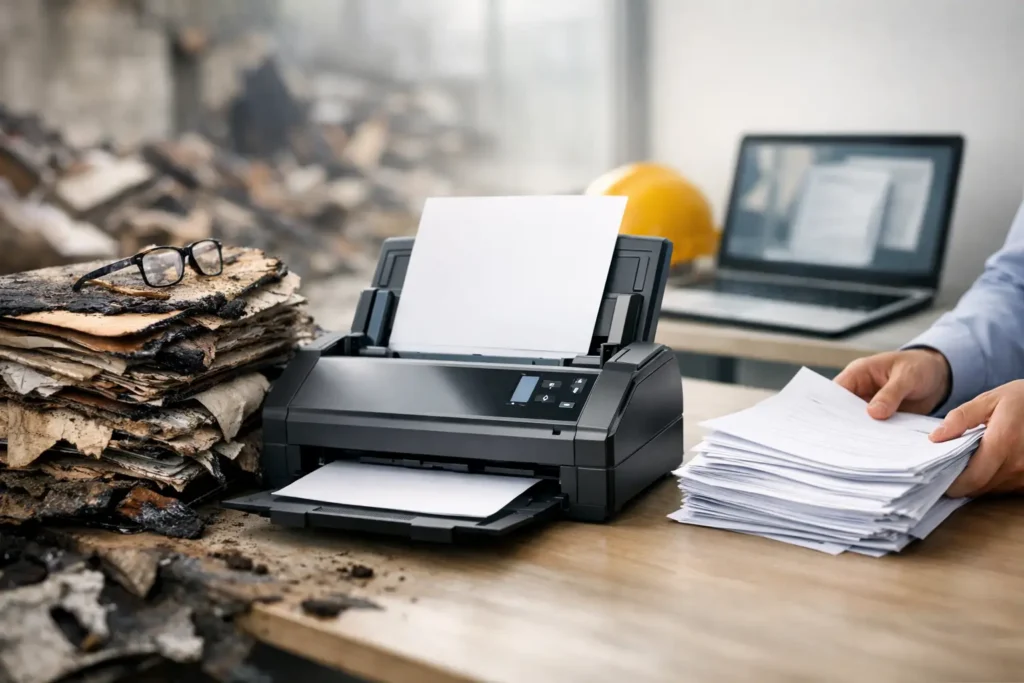
A broken pipe can soak a records room overnight. A roof leak can reach archived files before anyone notices. After a fire, smoke residue and water damage can make documents brittle, stained, and difficult to handle. Disaster recovery document scanning gives organizations a practical way to protect the information inside those records while the physical documents are assessed, restored, or retained for compliance.
For Houston businesses, law firms, healthcare offices, engineering teams, and corporate departments, the urgent question is rarely whether paper can be replaced. The question is whether the information can be recovered accurately, securely, and fast enough to keep operations moving. Client files, medical records, contracts, invoices, plans, discovery materials, and personnel documents may all be needed before the cleanup is complete.
What disaster recovery document scanning involves
This service is not simply feeding wet or damaged paper through a high-speed scanner. It is a controlled process that begins with assessing document condition and determining what can be safely imaged. Documents may need to be air-dried, separated, cleaned of surface debris, or handled one sheet at a time before scanning can begin.
The goal is to create readable, organized digital files that preserve the records’ useful content. Depending on the job, that may mean searchable PDFs, image files, indexed folders, or data that can be loaded into a document-management or litigation-support workflow. If the records could become evidence, quality control and chain-of-custody procedures matter just as much as scan speed.
A qualified scanning provider should document how materials are received, tracked, prepared, scanned, reviewed, and returned or securely retained. That visibility helps an organization make sound decisions when the situation is changing by the hour.
The first 48 hours: protect records before scanning
The best scanning results begin before the scanner is turned on. When a document incident occurs, staff should avoid trying to dry large quantities of paper with heat or forcing wet pages apart. Those actions can cause pages to stick, curl, tear, or lose ink. Instead, isolate the affected materials, limit unnecessary handling, and identify records that are immediately needed for business, legal, patient-care, or insurance purposes.
It also helps to separate records into practical groups: dry documents, damp documents, heavily saturated materials, confidential files, and records requiring urgent access. This does not need to be a perfect archival classification. It is a working triage process that helps the recovery team prioritize the documents that matter most.
Photograph the affected area and label boxes or file groups before moving them whenever possible. For legal, healthcare, and regulated business records, basic documentation of condition and movement can become valuable later. If records are part of an active matter, preserve originals and involve counsel or litigation-support personnel before making disposal decisions.
Prioritize information, not just paper volume
A common mistake is to begin with the largest stack or the most visibly damaged box. A better approach is to start with the information that restores the most operational capability. That could be current client files, accounts payable records, employee information, project specifications, or active case documents.
For an engineering firm, oversized plans and field documentation may be the priority. For a medical office, continuity of care may depend on fast access to patient records. For a law firm, upcoming deadlines may make pleadings, exhibits, correspondence, and discovery collections the first materials to process. Prioritization should reflect the real cost of being unable to locate a record.
How the scanning process protects usable information
Once records are stable enough to handle, the imaging work should follow a repeatable production process. Pages are prepared carefully, scanned at an appropriate resolution, and reviewed for legibility, completeness, orientation, and correct file grouping. Torn pages, folded sheets, faint text, handwritten notes, photographs, and tabbed sections may require special handling.
Color scanning is often worth considering after water, smoke, or staining damage because subtle marks can be lost in black-and-white imaging. On the other hand, black-and-white scanning can be efficient for clean text documents where color carries no meaning. The right choice depends on the record type, condition, anticipated use, and storage requirements.
Optical character recognition can make scanned records searchable, which is especially helpful when teams need to find names, account numbers, addresses, or key terms quickly. OCR is useful, but it is not perfect. Handwriting, degraded pages, unusual fonts, and damaged text can reduce accuracy. For critical records, searchable text should support the image, not replace visual review of the original scan.
Quality control is where recovery projects succeed or fail
A recovered file is only useful if the right pages are present and readable. Quality control should catch missing backsides, duplicate pages, cut-off margins, poor contrast, incorrect rotation, and file naming errors before records are delivered. This is particularly important when boxes have been disturbed during cleanup or when files arrive out of order.
Indexing also deserves attention. A folder full of files named Scan001 through Scan900 may technically preserve information, but it does little to restore access. Files should be organized around the way the organization needs to retrieve them: patient number, case name, project number, department, date range, or another meaningful identifier.
The Document Group can coordinate scanning, secure file delivery, and related print or litigation-support needs through a single locally managed project. That can reduce handoffs when an organization needs damaged records digitized while also preparing replacement binders, copies, exhibits, or oversized plans.
When originals still need to be retained
Digitizing a damaged document does not automatically mean the original can be discarded. Retention requirements vary by industry, record type, insurance claim, legal hold, and organizational policy. Signed agreements, regulated healthcare documentation, financial records, and potential evidence may require originals to be retained even after high-quality scanning.
This is an area where the answer depends on the circumstances. A routine internal reference file may be eligible for secure destruction after review and approval. A document connected to litigation, an audit, a claim, or a contractual dispute may need to remain preserved in its original condition. Organizations should involve their legal, compliance, records-management, or insurance contacts before disposing of damaged source documents.
Digital copies should also be stored in a location that is separate from the incident site. If an office server, local drive, or on-premises file room was affected, placing recovered files back into the same vulnerable environment creates a second risk. Access controls, backup practices, retention policies, and user permissions should be part of the recovery plan.
Build a scanning plan before the next incident
Disaster recovery is easier when the decisions have already been made. Organizations with high-value paper archives should identify which records are mission-critical, who has authority to approve emergency scanning, how confidential materials will be transported, and where digital files will be delivered. A current contact list and a simple records-priority list can save significant time.
It is also worth considering proactive scanning for archives that are frequently used or difficult to replace. Converting active paper records before an incident reduces both recovery cost and business interruption. Still, not every archive needs immediate digitization. The strongest approach focuses first on documents with high operational value, frequent retrieval needs, legal sensitivity, or limited replacement options.
When paper records are damaged, speed matters, but careless speed can create new problems. A responsive recovery partner should bring order to the situation: careful intake, secure handling, accurate scanning, practical file organization, and clear communication about what has been completed and what still needs attention. That is how a damaged records room becomes a manageable recovery project instead of a prolonged business disruption.