
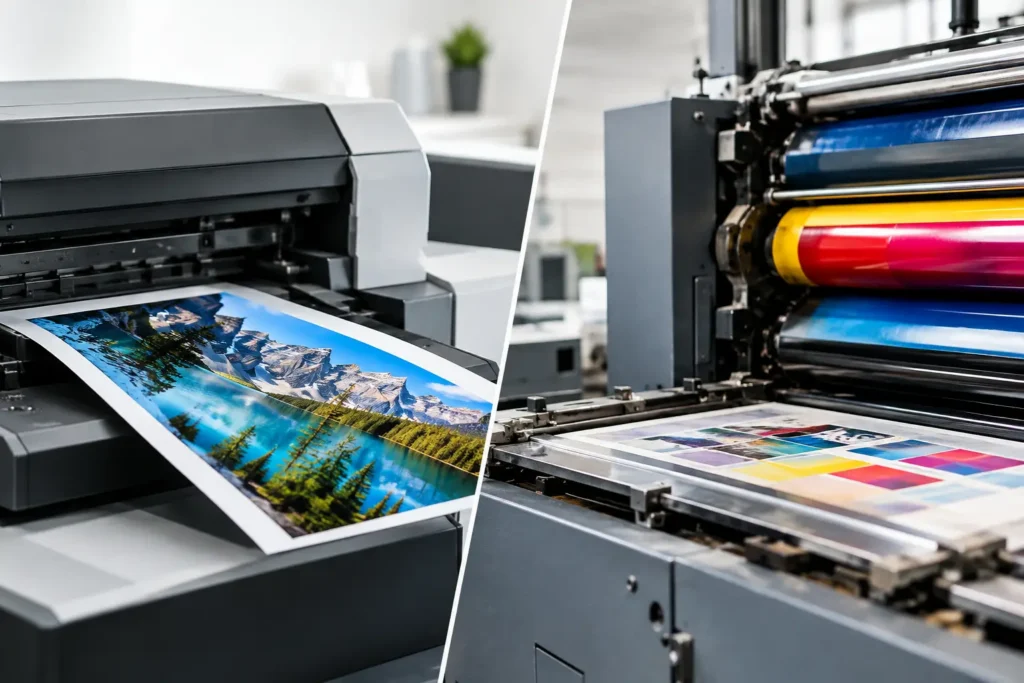
A print order can look simple until the deadline, quantity, color expectations, and finishing requirements land on the same desk. A 100-piece set of meeting packets needed tomorrow calls for a different production approach than 25,000 product sheets for a regional rollout. In the digital versus offset decision, the right answer is not about choosing the newer technology or the traditional one. It is about matching the process to the job.
For Houston organizations managing routine business materials, legal exhibits, engineering documents, direct mail, or event graphics, that choice affects cost, speed, consistency, and the final impression your materials make. A capable print partner should help you make the call before production begins, not after the job has become urgent.
Digital Versus Offset Printing: The Core Difference
Digital printing transfers an image directly from a digital file to paper or another approved substrate. It does not require custom printing plates. That shorter setup process makes digital printing especially effective for short runs, variable data, quick revisions, and deadline-driven work.
Offset printing uses plates to transfer ink to a rubber blanket and then onto the printed sheet. Plate setup takes more time upfront, but once the press is running, offset becomes highly efficient for larger quantities. It also offers exceptional consistency and broad flexibility in inks, paper stocks, and specialty finishes.
Neither method is automatically better. Digital printing is often the practical choice when speed and flexibility lead the conversation. Offset printing tends to take the lead when volume, exact color control, or a highly specific finished look matters most.
When Digital Printing Is the Better Fit
Digital is built for work that needs to move quickly. Because there are no plates to create, files can go from approval to production with far less lead time. That matters when an office needs sales sheets for an unexpected meeting, a legal team needs updated trial binders, or an event coordinator needs revised programs after a sponsor change.
Shorter runs are another clear advantage. Ordering 50, 200, or 500 pieces digitally is often more economical because the setup cost is low. With offset, the same plate and press preparation is required whether the order is small or large. For a limited quantity, that upfront cost can outweigh the per-piece savings of offset.
Digital printing also makes personalization possible without stopping production between versions. Names, addresses, case numbers, barcodes, location-specific details, or different images can change from one piece to the next. For organizations handling mailers, training packets, internal communications, or labeled document sets, this capability can reduce manual work and prevent assembly errors.
Revisions are less disruptive, too. If a phone number changes, a pricing chart needs correction, or a late document must be added to a presentation, the file can be updated without remaking plates. That does not remove the need for careful proofing, especially in legal, healthcare, and technical work. It does give teams more room to respond when information changes close to a deadline.
Digital quality is strong for most everyday commercial applications. Modern equipment produces sharp text, clear images, and professional color for business cards, brochures, reports, manuals, booklets, posters, and presentation materials. For many jobs, the difference between well-produced digital and offset printing will not be noticeable to the intended reader.
When Offset Printing Makes More Sense
Offset printing earns its place when the quantity is high enough to spread the initial setup expense across a large run. As volume increases, the per-piece cost generally drops. A company ordering thousands of brochures, product inserts, annual reports, catalogs, or branded forms may find offset is the more cost-effective option.
Color requirements can also make offset the better choice. Standard digital production commonly uses four-color process printing: cyan, magenta, yellow, and black. Offset can use the same process colors, but it also accommodates spot colors, including specific Pantone colors, with a high degree of control. When a brand depends on a precise signature color across major campaigns or nationally distributed materials, that control matters.
Offset offers wider flexibility with paper and specialty materials. While digital presses support an impressive range of approved stocks, offset can be the better route for unusual textures, very light or heavy sheets, specialty coatings, and select finishing effects. The desired feel of the piece may be just as relevant as the image printed on it. A premium invitation, high-end lookbook, or corporate publication may call for a stock and finish that deserve an offset conversation.
Consistency is another strength. Once an offset press is calibrated and running, it can produce long runs with dependable visual uniformity. This is valuable for materials that will be printed in large quantities and distributed over a broad area, where a small color shift between batches may be noticeable.
Offset does require more planning. It is not the best choice for every rush job, particularly when the order is small or the artwork is still changing. The files need to be final, approvals need to be clear, and production time must account for plate creation, press scheduling, drying when applicable, and finishing.
Cost Depends on Quantity, Not Just Price Per Piece
The most common mistake in comparing print methods is to look only at the unit price. A lower price per brochure does not help if the job requires a high minimum quantity, long lead time, or storage space your organization does not need.
Digital printing generally has a lower entry cost. That makes it useful for smaller quantities, test runs, versioned documents, and materials that may change frequently. A marketing team can print a limited campaign, review response, and refine the next version without committing to a large inventory.
Offset has higher setup costs but may deliver a lower unit cost at volume. The break-even point varies by project. Size, ink coverage, paper, number of colors, finishing, shipping, and turnaround all affect the calculation. Rather than relying on a fixed quantity rule, request estimates for both methods when a project sits near the middle range. The best choice may become clear once the complete production requirements are priced.
There is also a cost to obsolescence. If your brochure contains seasonal offers, changing personnel, or regulatory details that may be updated, printing fewer pieces digitally can be less expensive overall than discarding outdated offset inventory later.
Quality Is More Than Resolution
A high-resolution file is only one part of print quality. The quality of the original artwork, the paper selection, color management, proofing process, trimming, folding, binding, and final inspection all influence the finished product.
For technical and legal documents, readability is often the priority. Fine text, line weights, tabs, exhibit labels, Bates-numbered pages, and section dividers must reproduce cleanly and remain organized through copying, binding, and handling. Digital printing is frequently well suited for these time-sensitive document sets, particularly when different recipients require different versions.
For customer-facing marketing pieces, appearance may carry more weight. A brand campaign with large color fields, carefully matched logo colors, premium paper, or special coatings may benefit from offset production. Still, digital may be preferable if the campaign needs localized messaging, short runs, or rapid replenishment.
Ask for a proof when color, content, or finishing is critical. A proof creates a checkpoint before the full run and helps ensure everyone agrees on the expected result. It is one of the simplest ways to protect a budget and a deadline.
How to Choose the Right Process for Your Project
Start with the deadline and the number of finished pieces you actually need. Then consider whether each copy will be identical, whether the content could change, and how exact the color needs to be. Paper selection and finishing requirements should enter the conversation early rather than after the job has been quoted.
A few practical questions can guide the decision:
- Is this a short run or a high-volume order?
- Is the artwork final, or are late revisions likely?
- Does each piece need different names, addresses, codes, or content?
- Does the project require an exact spot color, specialty stock, or premium finish?
- Is the delivery date fixed, especially for a hearing, event, presentation, or product launch?
For projects with a hard deadline, the production method is only part of the equation. File preparation, proof approval, finishing, pickup, delivery, and communication all need to stay on track. This is where working with one accountable production partner can remove unnecessary coordination from the process.
The Document Group helps clients evaluate print requirements against the real conditions of the job: quantity, deadline, color, finishing, versioning, and delivery. That is particularly useful when a project includes more than printing, such as scanning source documents, producing bound sets, creating oversized exhibits, or coordinating materials for multiple locations.
The practical choice is the one that gives your organization the right result without paying for capacity, time, or inventory it does not need. Bring the details of your next project to the conversation early, and the print method becomes a production decision instead of a last-minute gamble.