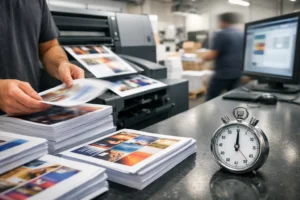
A 4 p.m. request for 300 bound proposal packets. Revised trial exhibits needed before court opens. Trade-show graphics that must be on the truck by morning. These are the moments when same day commercial printing is not a convenience. It is part of keeping the business moving.
Fast production only helps when the final materials are accurate, professional, and ready to use. A rushed job with a missing page, incorrect fold, weak color, or late delivery can create more work than it saves. The right print partner treats an urgent order as a managed production project, not simply a file sent to a printer.
What Same Day Commercial Printing Requires
Same-day service begins well before the presses start. It depends on clear communication, production capacity, file review, proofing decisions, finishing requirements, and a realistic delivery plan. The more complex the project, the more these details matter.
For a straightforward black-and-white document, the turnaround may be quick with few questions. A legal brief with tabs and Bates numbering, a full-color sales kit with custom binding, or a set of oversized engineering plans requires more coordination. The deadline can still be met, but the production team needs to understand exactly what must be produced and where it needs to go.
This is why local service has real value. When the team handling the job is in Houston, it can review the request directly, flag a problem early, arrange pickup or delivery, and stay accountable through completion. There is no need to wonder whether an online order has entered a queue somewhere outside the market.
Speed Should Not Mean Skipping Quality Control
A print deadline creates pressure, but it should not eliminate the checks that protect the final result. Before production, an experienced team confirms the file size, page count, color setup, stock selection, finishing instructions, and quantity. For multi-part document sets, it also verifies the order of files and whether each section requires different treatment.
That process is especially important for materials with high stakes. Legal teams may need exhibit labels, confidential handling, accurate reproductions, and consistent tabs. Healthcare organizations may need records copied or scanned with careful attention to privacy and legibility. Engineering and construction teams need plans printed at the correct scale, with line weights that remain clear in the field.
The goal is not to slow the work down. It is to prevent a five-minute oversight from becoming a missed deadline or an expensive reprint.
Decide What Is Truly Needed Today
Urgent projects are easier to manage when the team separates must-haves from nice-to-haves. If a presentation is scheduled for tomorrow morning, the printed packets, covers, and delivery location are essential. A specialty paper choice or an extra finishing detail may be worth reconsidering if it puts the deadline at risk.
That does not mean every rush project has to look basic. Digital color printing can produce polished, professional materials quickly, while a variety of binding, laminating, folding, cutting, and mounting options can make a short-run project presentation-ready. The right choice depends on the purpose of the piece.
For example, a board meeting packet may call for color tabs, double-sided printing, and coil or wire binding. A sales handout may need a clean trim and heavier cover stock. A construction bid set may require full-size and half-size plans, collated in a specific sequence. A last-minute event need may involve banners, directional signs, table graphics, or mounted displays.
The key is to tell the production team how the item will be used. A document that will be read at a conference table has different requirements than one that will be handed out outdoors, posted in a storefront window, or reviewed by a judge.
Start With Files That Are Ready for Production
Even the best-equipped print operation cannot recover time lost to incomplete files. Sending print-ready PDFs is usually the fastest path, particularly for documents with precise page layouts, embedded fonts, and images. Before sending files, confirm that the pages are final, the document is at the intended size, and the page order is correct.
For full-color work, image resolution deserves a quick check. A low-resolution image may look acceptable on a laptop but appear soft or pixelated when printed. For oversize graphics, resolution and scale are even more important. A small image enlarged into a banner may not deliver the visual impact expected from a trade-show display or storefront graphic.
If the project includes bleeds, crop marks, variable data, tabs, divider sheets, or specialty finishing, say so at the beginning. Those details affect both setup and production time. A clear filename structure also helps when several versions, languages, or departments are involved. Names such as “Final,” “Final 2,” and “Use This One” invite confusion when minutes matter.
When files are not ready, a capable local print provider can often help identify the issue and recommend a practical path forward. That support is valuable, but it should be requested early. The sooner a problem is found, the more options remain.
Give the Production Team the Right Job Details
A fast quote and accurate turnaround estimate depend on more than page count. A complete request should identify the finished size, color or black-and-white printing, one-sided or two-sided pages, paper preferences, quantity, binding or finishing, and required delivery time. For sensitive projects, include handling requirements and the authorized point of contact for approvals.
Delivery details matter just as much. A job needed at a downtown office at 8 a.m. requires a different plan than one being picked up from a Houston location later that afternoon. If materials are headed to a courthouse, convention center, jobsite, or hotel, provide the receiving contact, room or booth number, and any access restrictions.
For large or recurring projects, account-manager oversight can make the process substantially easier. Instead of re-explaining requirements every time, teams can establish specifications, preferred stocks, file conventions, routing instructions, and approval procedures. That consistency is useful for office materials, litigation copying, medical-record projects, training manuals, and franchise or multi-location marketing programs.
When Digital Printing Is the Right Rush Option
Digital printing is often the practical answer for same-day quantities because it avoids the plate-making and setup associated with traditional offset production. It works well for short-run brochures, manuals, training materials, presentation packets, mailers, signage, and business documents that need clean color and a quick turnaround.
Offset printing may still be the better fit for higher-volume work, exact color matching, or long-term production planning. The trade-off is lead time. If a campaign is planned weeks ahead, offset can offer advantages in unit cost and consistency. If the materials are needed this afternoon, digital production is generally the more realistic option.
The same principle applies to finishing. Standard cuts, folds, stapling, and common binding options are usually easier to accommodate quickly than highly specialized finishes. A knowledgeable provider will explain what can be completed by the requested deadline without overpromising.
Trust Matters Most on High-Stakes Work
Not every urgent print request is a marketing emergency. Some involve discovery documents, deposition exhibits, medical records, compliance files, disaster recovery, or confidential business information. In those situations, fast turnaround must be paired with secure handling and dependable chain-of-custody practices.
A vendor that understands both printing and document management can reduce handoffs. The same team may be able to scan paper records, organize digital files, produce working copies, print exhibits, create trial graphics, and deliver finished materials where they are needed. Fewer vendors can mean fewer opportunities for files to be misplaced, instructions to be lost, or deadlines to drift.
At The Document Group, rush work is handled with the same hands-on project ownership as planned production, including local pickup and delivery options when timing calls for it. That level of accountability matters when a deadline is connected to a hearing, a client meeting, an inspection, or an event opening.
A Better Way to Handle the Next Urgent Request
The best time to prepare for a rush job is before the next rush job arrives. Keep approved brand assets and current templates organized. Establish a clear internal approval contact. Save reliable specifications for recurring projects. If your team regularly produces plans, litigation materials, training packets, or event graphics, discuss expected turnaround needs with your print partner before the calendar becomes crowded.
Then, when an unexpected deadline lands on your desk, send the most complete request you can and make the decision-maker available for questions. Fast printing works best as a collaboration: your team provides clear direction, and the production team takes ownership of getting the details right.
When the clock is tight, choose a partner that can give you a direct answer, a realistic production plan, and a finished piece you can put to work with confidence.